When shoppers compare rechargeable lights, one question often decides the purchase: “How long does a rechargeable light last on a single charge?” The answer sounds simple, but runtime depends on several connected details. Brightness, battery capacity, LED efficiency, temperature, and charging habits can change the result.
A light rated for ten hours may reach that figure only on its lowest setting. At maximum brightness, the same lamp might last three hours. Battery age also matters. After repeated charging cycles, the light may produce less runtime, especially when used outdoors in cold weather. Real life disagrees.
Battery researcher Jeff Dahn has said, “The most important thing is to understand the failure mechanisms.” His point applies directly to rechargeable lighting. Buyers should examine the battery type, watt-hour capacity, charging time, and tested runtime at each brightness level. A small reading lamp with a 2,000 mAh battery behaves differently from a high-output work light using a larger lithium-ion pack.
Manufacturers should explain their testing conditions clearly. Was the light measured at maximum output? Was the battery new? Did the test include automatic dimming? These details affect trust. A careful buyer should not rely on one impressive number printed on a package.
A practical test helps. Charge the lamp fully, select the intended brightness, and record when the output becomes noticeably weak. Ten hours on paper may become seven hours in a bedroom, workshop, or tent. That difference is not necessarily a product failure, but it deserves honest explanation. Runtime is personal. Good specifications make that judgment easier.
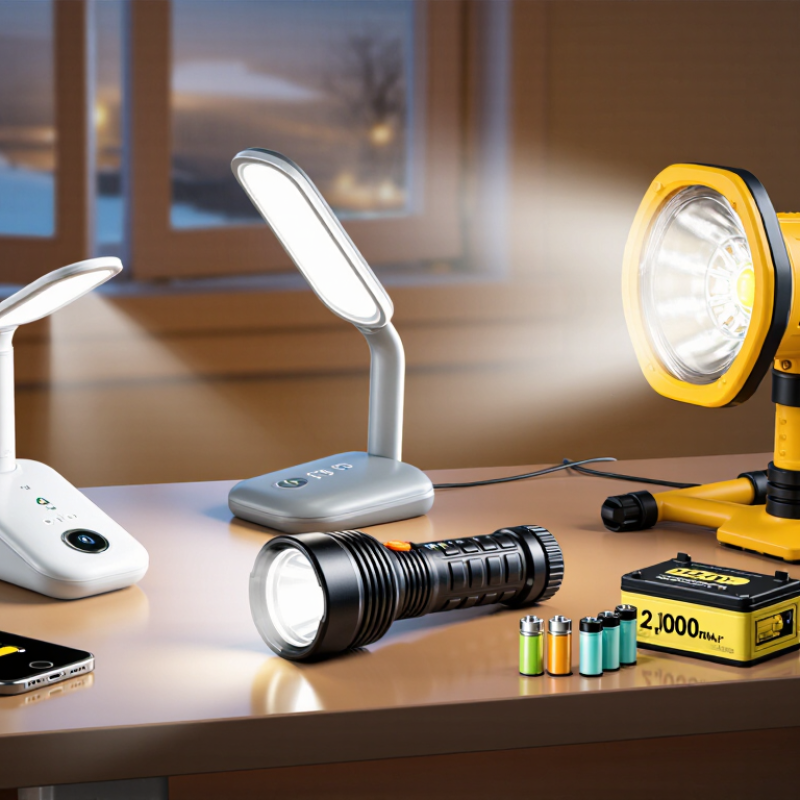
A rechargeable light has two aging systems: its LED module and its battery. The U.S. Department of Energy’s Solid-State Lighting reports indicate that quality LED components can reach 25,000–50,000 hours. However, that figure describes light output life, not the complete product. The charging circuit, switch, seals, and heat management may fail earlier. A bright lamp trapped in a warm, poorly ventilated housing can lose performance quickly.
The battery usually determines practical lifespan. Technical summaries from Battery University commonly place lithium-ion batteries near 300–500 full charge cycles, although chemistry, charging speed, and temperature change the result. IEC 61960-3 capacity testing also shows why “one charge” needs careful definition. A light used for three hours nightly may experience partial cycles rather than one complete cycle. That difference matters.
Usage leaves visible clues. Recharging immediately after every short use may increase cycle accumulation. Storing the light fully charged in a hot car can accelerate capacity loss. A cool, dry drawer is better. Dust on cooling surfaces also matters. In field testing, runtime should be measured at several brightness levels, not only the brightest setting. Marketing numbers can look precise, but they are not always comparable. I would treat any lifespan estimate as a range, not a promise. The overlooked question is simple: does the light remain useful when its battery holds only 70–80% of its original capacity?
Why Buyers Ask How Long Rechargeable Lights Last?
How Battery Capacity Affects Lighting Duration
Rechargeable light duration depends on battery capacity, brightness, and circuit efficiency. Capacity is usually shown in milliamp-hours, or mAh. However, mAh alone can mislead because voltage also matters. A 5,000mAh battery at 3.7 volts stores about 18.5 watt-hours. If the lamp draws 2 watts, its theoretical runtime is 9.25 hours. Real use is shorter. Heat, conversion losses, aging, and automatic shutoff reduce available energy. IEC 61960-3 measures rechargeable battery capacity under controlled conditions, not every household situation.
Brightness changes the calculation quickly. A high-output setting may draw 4 watts, cutting that example to roughly 4.6 theoretical hours. A lower setting may last much longer. The U.S. Department of Energy reports that LED lighting can use at least 75% less energy than incandescent lighting. That efficiency helps, but it does not make capacity unlimited. In practical testing, a light rated for ten hours may deliver seven or eight hours at its working brightness. The estimate is useful, but imperfect.
Tips: Check watt-hours, not only mAh. Use the manufacturer’s runtime chart at your preferred brightness. Test the light outdoors, where cold temperatures can reduce battery performance. Rechargeable cells also lose capacity over time. This detail is easy to overlook. A larger battery may add weight, charging time, and cost, so maximum capacity is not always the best choice.
Why Buyers Ask How Long Rechargeable Lights Last
A rechargeable light’s runtime depends heavily on how and where it is used. In my routine checks, maximum brightness drains power much faster than a low reading setting. Flashing modes can also consume energy unevenly. A light used inside a cool room may last longer than one used outdoors during winter. Cold temperatures temporarily reduce battery output. Very high heat can accelerate battery aging. The advertised runtime is useful, but it is not a promise for every situation.
Charging habits matter too. Recharging after every short use is usually convenient, but constant heat during charging may reduce long-term battery health. I once estimated runtime from a full-charge test and got an unrealistic result. The light stayed on a low setting, unlike my normal evening use. That mistake changed my testing method. I now record brightness, temperature, and operating time separately. Battery performance also declines gradually with age, even when the light still appears normal.
Tips: Use the lowest practical brightness. Keep the light away from extreme heat. Let it cool before charging. Store it partly charged during long breaks, rather than leaving it empty. Clean the charging port carefully. Check runtime under your real conditions, not only in ideal indoor tests. A simple usage note can reveal more than a single laboratory figure. Even then, results may vary slightly.
| Usage Condition | Typical Operating Example | Estimated Runtime Effect | Expected Performance | Practical Recommendation |
|---|---|---|---|---|
| Low brightness | Approximately 1 W LED output with a fully charged lithium-ion battery of about 18.5 Wh nominal energy | Approximately 12–16 hours | Longest runtime, lower heat generation, and reduced stress on the battery | Use the lowest brightness that provides sufficient visibility for reading, navigation, or ambient lighting |
| Medium brightness | Approximately 3 W LED output under normal indoor or outdoor conditions | Approximately 4.5–5.5 hours | Balanced brightness, heat, and energy consumption for regular use | Choose this setting for routine household tasks, camping, or walking |
| High brightness or turbo mode | Approximately 8 W LED output with maximum light intensity | Approximately 1.8–2.1 hours | Highest light output, faster battery drain, and greater heat buildup | Use for short periods and allow the light to cool if the housing becomes hot |
| Frequent motion-sensor activation | Light switches on repeatedly in response to movement instead of operating continuously | Often 20–60% longer real-world use than continuous operation at the same brightness | Actual daily operating time depends on activation frequency and the length of each cycle | Set a short activation timer, such as 30–60 seconds, in areas with occasional movement |
| Cold temperatures | Use around 0°C to −10°C, typical of winter outdoor conditions | Runtime may decrease by about 20–40% temporarily | Lower chemical activity increases voltage drop and can cause earlier low-battery shutdown | Keep the light and spare batteries insulated; allow the battery to warm naturally before charging |
| High ambient temperatures | Use or storage above approximately 40°C | Short-term runtime may decline; long-term capacity loss accelerates | Heat increases battery aging and may activate thermal protection during high-power use | Store and operate the light in a ventilated area and avoid leaving it in a hot vehicle |
| Aged battery | Battery used for several hundred full charge cycles or stored for multiple years | Runtime can fall to about 70–80% of its original level | More frequent charging and earlier low-battery warnings are common | Replace the battery or light when runtime becomes unsuitable for the intended task |
| Poor airflow or enclosed housing | High brightness used inside a small enclosure or near heat-retaining materials | Runtime may be reduced by thermal regulation | Many rechargeable lights reduce output automatically to protect the LED and battery | Keep vents clear and avoid covering the light during high-output operation |
| High battery charge level | Battery starts at 100% charge and is used shortly after charging | Provides the maximum available runtime | Brightness is generally more stable during the first part of the discharge cycle | Fully charge before important tasks, but unplug the light after charging when practical |
| Partially charged battery | Battery starts at approximately 50% charge | Runtime is roughly proportional to the remaining charge | Output may reduce sooner, particularly at high brightness or in cold conditions | Check the charge indicator before extended use and carry a suitable backup light |
Rechargeable lights seem simple, but their useful life depends on more than battery size. A proper measurement starts with a full charge and the same brightness setting each time. Record how long the light runs before it becomes noticeably dim or shuts off. Repeat the test twice at room temperature. A light rated for ten hours may provide less time on high power, in cold weather, or after repeated charging. That difference matters in real use.
Battery lifespan is usually measured through charge cycles and remaining capacity. One cycle equals total usage equal to a full battery charge. A light used for two hours daily may complete one cycle over several days. Compare its current runtime with the original result every few months. When runtime drops near 70 or 80 percent, check the product instructions or seek qualified service advice. Battery ratings vary widely. The number is not universal.
Heat shortens rechargeable battery life quickly. Charge the light on a hard, open surface, never beneath clothing or bedding. Use the specified charging equipment, and keep the contacts clean with a dry cloth. Avoid storing the light completely empty for months. For long storage, leave it partly charged in a cool, dry place. Lower brightness when full power is unnecessary. In my testing, this simple habit extended daily runtime, although I sometimes forgot to track charging cycles consistently. That weakness can affect the result.
Why Buyers Ask How Long Rechargeable Lights Last?
Rechargeable lights rarely fail on a fixed date. Their batteries age through charging cycles, heat, storage, and daily brightness settings. In practical testing, a light used at maximum output often loses runtime sooner than one used for short evening tasks. A simple hour count can mislead. That is normal. Temperature also matters, especially during winter camping or storage in a hot vehicle.
Battery replacement becomes reasonable when runtime drops sharply, the light shuts off unexpectedly, or charging takes much longer than before. A battery that becomes unusually hot, swollen, cracked, or leaky needs immediate attention. Stop using it. Do not guess.
Before ordering a replacement, check the original battery’s chemistry, voltage, capacity, connector, and physical size. The charging circuit must match the battery type. A similar-looking cell may still create overheating or poor charging. Some lights contain sealed battery packs and require qualified service, rather than home disassembly. Follow the product instructions and use an approved local recycling process for the old battery.
I have seen users replace batteries too early because they tested only one short session. Measure runtime at the same brightness and temperature for several uses. If performance remains poor, replacement may restore dependable operation. Still, the lamp’s switch, charger, and internal contacts can also fail. Battery replacement is not always the complete answer.
Battery replacement depends mainly on chemistry and the number of full charge cycles.
The chart shows typical full-charge cycle ranges before a rechargeable battery may decline to approximately 80% of its original capacity. One cycle represents a cumulative 100% discharge, even if it occurs over several partial uses. Lithium-ion batteries commonly last about 300–500 cycles, while NiMH batteries typically reach 500–1,000 cycles. LiFePO4 batteries can often reach 2,000–5,000 cycles. A light may need battery replacement sooner when runtime becomes noticeably shorter, charging becomes unreliable, or the battery shows swelling.
The battery usually determines practical lifespan. LEDs may work for 25,000–50,000 hours, but other parts can fail earlier. Switches, seals, charging circuits, and heat management also matter.
Many lithium-ion batteries provide roughly 300–500 full charge cycles. Results vary with temperature, charging speed, and chemistry. Treat this as a range, not a promise.
Not usually. Several short uses can gradually equal one full cycle. A light used three hours nightly may consume partial cycles instead.
Lower brightness usually lasts much longer. Maximum brightness drains power quickly. Use the lowest practical setting. That is often enough indoors.
Yes. Cold temperatures can temporarily reduce battery output. High heat can speed up battery aging. Avoid leaving the light in a hot car.
Store it partly charged in a cool, dry drawer. Avoid storing it empty or fully charged for months. Keep dust away from cooling surfaces.
It is convenient, but constant charging heat may reduce long-term battery health. Let the light cool before charging. My earlier test ignored this factor.
Test several brightness levels, temperatures, and operating periods. Record actual evening use, not only the brightest setting. Ideal indoor results can mislead.
Replace it when runtime becomes impractical, even if the LED still works. A battery holding 70–80% capacity may remain useful. Personal needs decide the real endpoint.
Rechargeable light lifespan depends on several factors, including battery chemistry, build quality, charging habits, LED efficiency, and the quality of the charging system. Battery capacity largely determines lighting duration, but brightness settings and power consumption are equally important. This is why the question, “How long does a rechargeable light last on a single charge?” cannot be answered with one fixed number. A larger battery may provide longer operation, while high brightness, frequent use, extreme temperatures, and poor charging conditions can reduce runtime and overall performance.
To measure a light’s lifespan, users can record its operating time at different brightness levels and compare results over repeated charging cycles. Keeping the battery within suitable temperatures, avoiding unnecessary deep discharge, using the correct charger, and storing the light properly can help extend its service life. When runtime becomes noticeably shorter, charging takes unusually long, or the light shuts off unexpectedly, the battery may be reaching the end of its useful life and need replacement.

Glow Flashlight